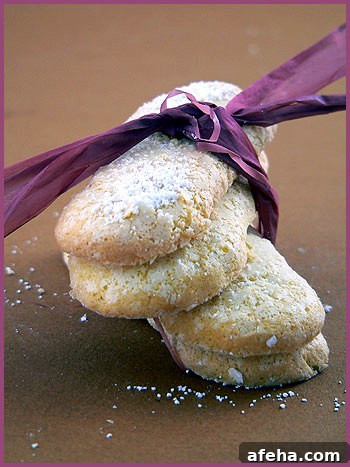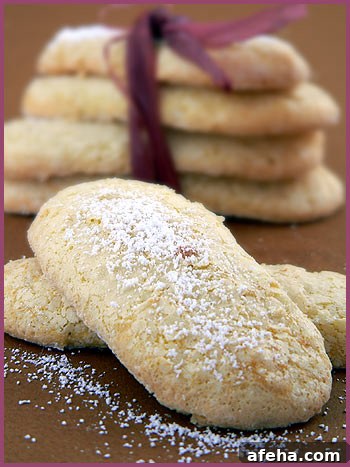
Me: “— What am I going to do?
P.: — What do you mean?
M.: — Je ne les trouve pas ! Ils n’en ont pas !
P.: — They don’t have what?
M.: — Des biscuits à la cuillère!
P.: — What?
M.: — Ladyfingers! I need some to make my dessert!
P.: — Can’t you make some?
M.: — Ca va pas la tête ? T’es pas fou ? (Are you nuts?)
P.: — Well, there must be a recipe somewhere. Yours will taste nicer anyway. Try!”
P. was right. Totally right. I remembered a hint from Sam long ago and decided to try making them myself. I needed ladyfingers for a dessert and the idea of finding a recipe finally pushed me to experiment.
When I lived in France, buying des biscuits à la cuillère was effortless. Any supermarket or small épicerie would carry them.
Moi : — Bonjour, je voudrais des biscuits à la cuillère, vous les rangez où ?
Vendeur : — Là-bas, dans le rayon des petits gâteaux.
Me: “— Hello, I would like to buy ladyfingers. Where do you keep them?
Shop assistant: — Over there, with the cookies.”
It was easy and taken for granted. Since moving away from France, I’ve learned to adapt. Living abroad pushes you out of your comfort zone and teaches small lessons every day. You learn to accept unfamiliar habits (and some baffling ones, like how callers sometimes ask for P. without introducing themselves), and you stop assuming things will be as they were back home. For food, this means sometimes hunting longer for ingredients or learning to make them yourself.
My Ladyfinger Search
I could have called every store in the neighborhood, but I didn’t want the firmer, drier ladyfingers commonly available here. I wanted the softer, wider kind—more like small sponge cakes—to achieve a specific texture for my dessert. It never occurred to me to make them until I found I couldn’t buy what I wanted. Once I realized vendors made and sold these biscuits, I figured I could make them too.
Mes biscuits à la cuillère
Originally, the biscuit’s shape was round, named after the spoon (la cuillère) used to place portions of batter on a baking sheet. Around the 19th century the shape changed to the long finger-like form we know today, piped from a pastry bag. Antonin Carême is often credited with popularizing them. Essentially, ladyfingers are small finger-shaped sponge cakes.
I needed wider, shorter ladyfingers for a dessert I’m obsessed with—one I’ll introduce later. After testing and adjusting, I settled on a recipe that gave me light, airy biscuits. They might not look as perfect as store-bought ones, but they had the texture I wanted: sweet, soft, and melting in the mouth. They reminded me of the biscuits my mum used to give me as a baby—soft enough for tiny gums and comforting. The result felt almost weightless, like snow melting on the tongue.
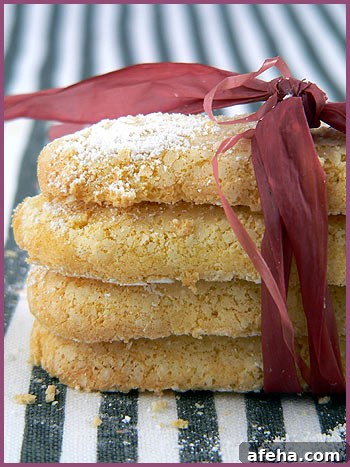
You need:
- 3 eggs
- About 6 Tbsp cornstarch
- About 6 Tbsp all-purpose flour
- 2.8 oz fine sugar
- Confectioner’s sugar
Steps:
- Preheat your oven to 350 F (180 C).
- Separate the egg yolks from the whites. With a stand mixer, beat the egg whites with 1 Tbsp sugar, then gradually add the remaining sugar until the whites are firm and form peaks.
- Sift the flour and cornstarch separately.
- Add the egg yolks to the whites in the mixer, folding gently.
- Fold in the two flours with a spatula, taking care to retain the airiness of the mixture.
- Line a baking sheet with parchment paper or a silicone baking mat.
- Pipe little sticks about 2.5–3″ long, spacing them so they have room to spread.
- Sprinkle with confectioner’s sugar and let rest 1 minute until the sugar is absorbed, then sprinkle a second time.
- Bake for about 15 minutes, or until they are a light golden color.
- Remove from the oven and let cool briefly, then transfer to a cooling rack to finish cooling.
To be followed…
Ingrédients :
- 3 œufs
- 40 g maïzena
- 40 g farine
- 80 g sucre
- Sucre glace
Étapes :
- Préchauffez votre four à 180 C.
- Séparez les jaunes des blancs. Montez les blancs en neige avec 1 c. à soupe de sucre, puis ajoutez le reste du sucre progressivement jusqu’à obtenir une texture ferme.
- Tamisez la farine et la maïzena séparément.
- Incorporez les jaunes d’œufs aux blancs fermes, toujours au mixeur.
- Ajoutez délicatement les deux farines à la main sans mixer pour ne pas faire retomber la préparation.
- Mélangez délicatement à la maryse.
- Sur une feuille de papier cuisson, utilisez une poche à douille pour former des bâtonnets de 6–7 cm, en les espaçant.
- Saupoudrez de sucre glace en deux fois, en laissant la pâte absorber le sucre entre les deux applications.
- Faites cuire environ 15 minutes jusqu’à légère coloration.
- Retirez du four et laissez refroidir sur une grille.
A suivre…